.webp)

Chronic pain triggered the invention of Scrambler Therapy. Before the 2000s, millions worldwide suffered from chronic neuropathic pain, often with no effective or sustainable treatment. Conditions such as post-herpetic neuralgia, diabetic neuropathy, and chemotherapy-induced peripheral neuropathy (CIPN) lacked reliable, non-addictive therapies.
Scrambler Therapy was created to address the limitations of traditional pain management, including:
The innovation imperative led to the development of non-invasive, neuromodulatory treatments that could interrupt the chronic pain cycle without drugs.
Up next: Who was behind this revolutionary therapy and what inspired the development?
Prof. Giuseppe Marineo invented Scrambler Therapy in Italy. A researcher in bioelectronics and neuro engineering, he was affiliated with the University of Rome Tor Vergata and led Delta Research & Development.
Giuseppe Marineo, an Italian physicist and research fellow, conceptualized Scrambler Therapy in the 1990s. His work focused on:
Marineo theorized that nociceptors and CNS circuits could be reprogrammed using synthetic “no pain” signals, effectively “scrambling” the brain’s interpretation of pain.
Coming next: How early prototypes of Scrambler Therapy were tested and refined.
The development phase of Scrambler Therapy spanned over a decade, from theoretical design to clinical-grade prototypes.
Marineo and his team built the first MC-5A prototype using:
Key experimental stages:
Early findings showed that chronic pain signals could be overridden without causing nerve damage or discomfort, unlike other electrical therapies.
Next: The theoretical breakthrough that shaped the therapy’s core.
Scrambler Therapy is rooted in information theory. Marineo drew on Claude Shannon’s work to build a model where pain signals are "data" transmitted through the nervous system.
The core concept involves:
Unlike TENS (Transcutaneous Electrical Nerve Stimulation), which blocks pain temporarily, Scrambler Therapy alters pain perception at a central processing level, producing longer-lasting relief.
Key differences from TENS:
Next: How clinical studies validated these theories.
Clinical validation began in Rome, where the first hospital-based trials evaluated the MC-5A’s safety and efficacy.
The first formal clinical study was published in 2003, involving patients with drug-resistant neuropathic pain. Key findings:
In double-blind trials comparing Scrambler Therapy with placebo and morphine, it consistently delivered superior long-term pain reduction.
Data points from early validation:
Next section: From trials to FDA recognition.
In 2009, the U.S. FDA cleared Scrambler Therapy as a Class II medical device for pain management.
Yes. After U.S. clearance, it earned:
Global regulatory milestones:
Next, we'll look at the evolution of the technology itself.
Scrambler Therapy devices have evolved significantly in hardware and software capability.
The original MC-5A has been followed by newer models like the MC-7, which offer:
Comparison:
New versions feature adaptive algorithms, allowing customized treatment protocols based on real-time patient feedback.
Next, the role of Scrambler Therapy in oncology.
Cancer patients often suffer from chronic neuropathic pain, especially from chemotherapy. Traditional solutions involve opioids, which carry major risks.
Scrambler Therapy was adopted into palliative care settings for:
Clinical data from cancer settings:
It has become a non-opioid alternative in pain management protocols, notably in hospitals that follow NCCN guidelines.
Coming next: Adoption by the military.
The U.S. Department of Defense and VA healthcare system adopted Scrambler Therapy to address combat-related chronic pain.
Introduced through pilot programs, Scrambler Therapy has been used for:
It’s been deployed in:
Benefits observed:
Next: How academia has embraced and validated the therapy.
Independent research institutions have replicated and validated early results, confirming its efficacy.
Studies have been conducted by:
Key themes:
Scrambler Therapy is listed in PubMed-indexed clinical research and has been the topic of multinational trials across Europe, Asia, and North America.
Next: Addressing misconceptions around the therapy.
Misunderstandings about Scrambler Therapy often hinder its adoption.
No. Scrambler Therapy:
Coming up: Final answers to common questions.
Giuseppe Marineo, an Italian biophysicist.
Development started in the 1990s, with the first device released in the early 2000s.
Yes, it received FDA Class II clearance in 2009.
It modifies pain perception centrally using dynamic information signals.
Yes. Studies show up to 85% pain relief in conditions like neuropathy and cancer pain.
It’s used in oncology, military, veteran care, and across global pain clinics.
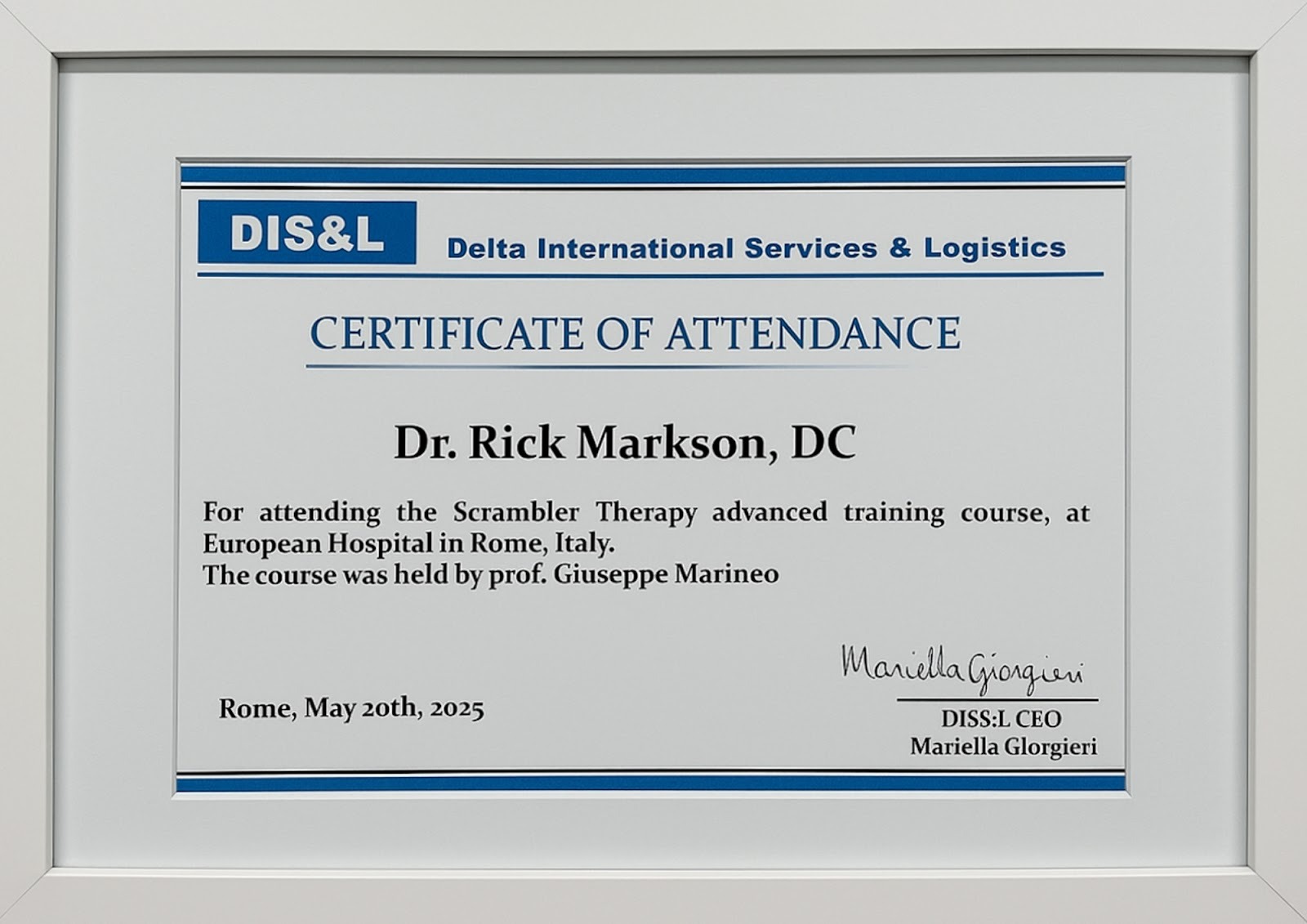
Discover South Florida Scrambler Therapy is one of the nation’s leading clinics for noninvasive chronic pain relief, offering FDA-cleared Scrambler Therapy® for adults and children. Co-founded by Dr. Rick Markson, one of the few practitioners worldwide to receive advanced certification directly from the therapy’s inventor in Rome, our clinic delivers globally recognized expertise with compassionate, personalized care. If you or a loved one is living with treatment-resistant nerve pain, we invite you to schedule a consultation and explore a life beyond pain.
📘 What is scrambler therapy?
📘 What to Expect During a Scrambler Session
📘 CRPS Pain Relief Without Drugs—Real Patient Stories
📘 Conditions that scrambler therapy can treat
Keep up to date with important news about our clinic and your medical records.


.svg)
.svg)
.svg)