Scrambler Therapy vs Medications: What Changes and When

Comparisons

Chronic neuropathic pain remains a complex condition that often persists despite standard treatments. This raises an important clinical question:

Should treatment focus on suppressing pain—or modifying how the nervous system processes it?

The comparison between Scrambler Therapy and medications reflects two distinct approaches to managing neuropathic pain: symptom control versus signal modulation.

Understanding the Core Difference

  • Medications primarily reduce pain perception
  • Scrambler Therapy aims to modify abnormal nerve signaling

Medication-Based Approach

Pharmacologic treatments such as opioids, gabapentinoids, and antidepressants act on the central nervous system to reduce pain signaling.

  • Opioids bind to μ-opioid receptors and alter pain perception
  • Gabapentin reduces excitatory neurotransmission
  • SNRIs enhance descending inhibitory pathways

These approaches can reduce symptoms, but they do not directly correct maladaptive nerve signaling, which contributes to chronic neuropathic pain.

👉 Neuropathic pain is associated with central sensitization and altered neural processing (Colloca et al., 2017, Nature Reviews Disease Primers)

Scrambler Therapy (Neuromodulation Approach)

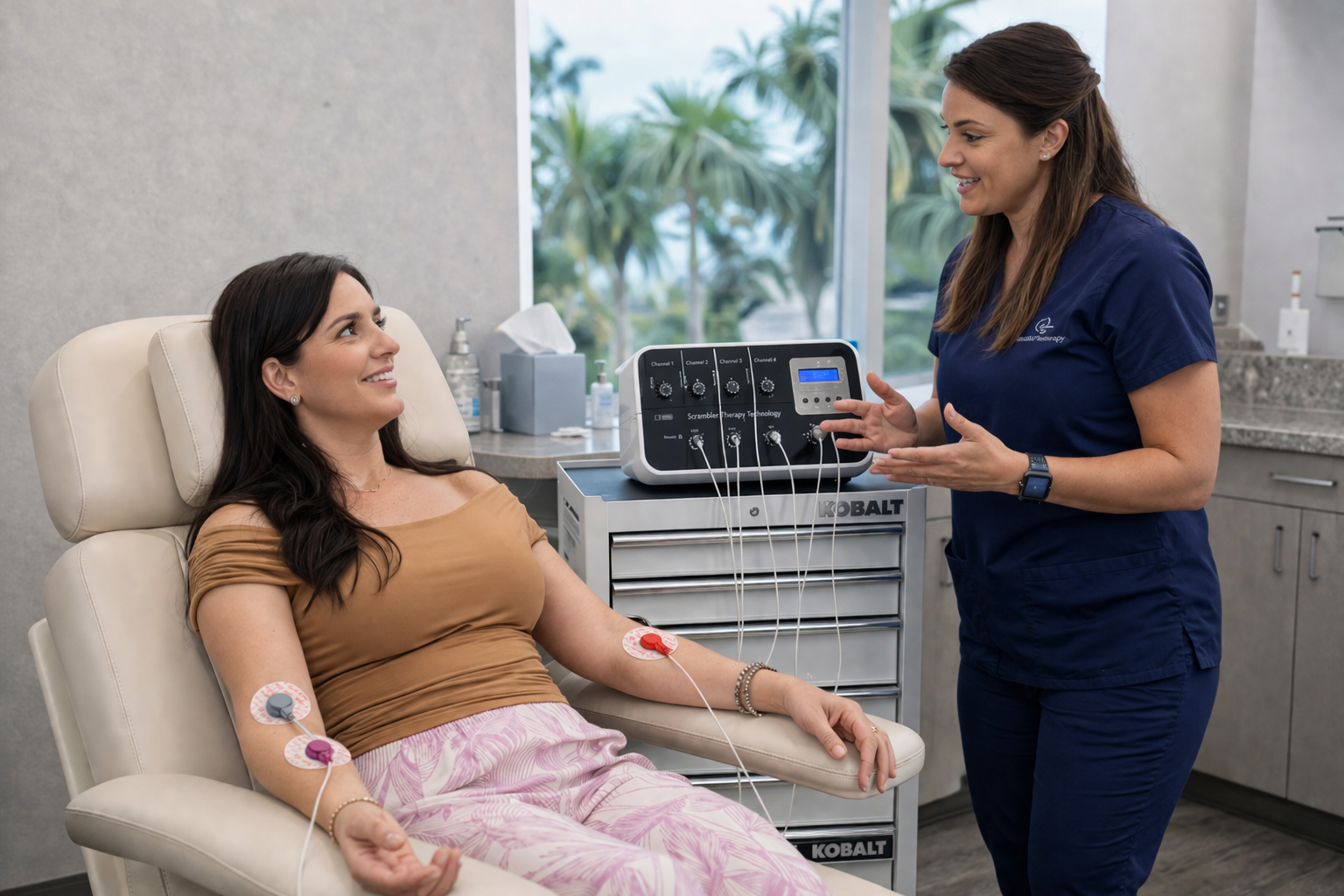
Scrambler Therapy is a non-invasive neuromodulation technique designed to alter peripheral nerve signaling.

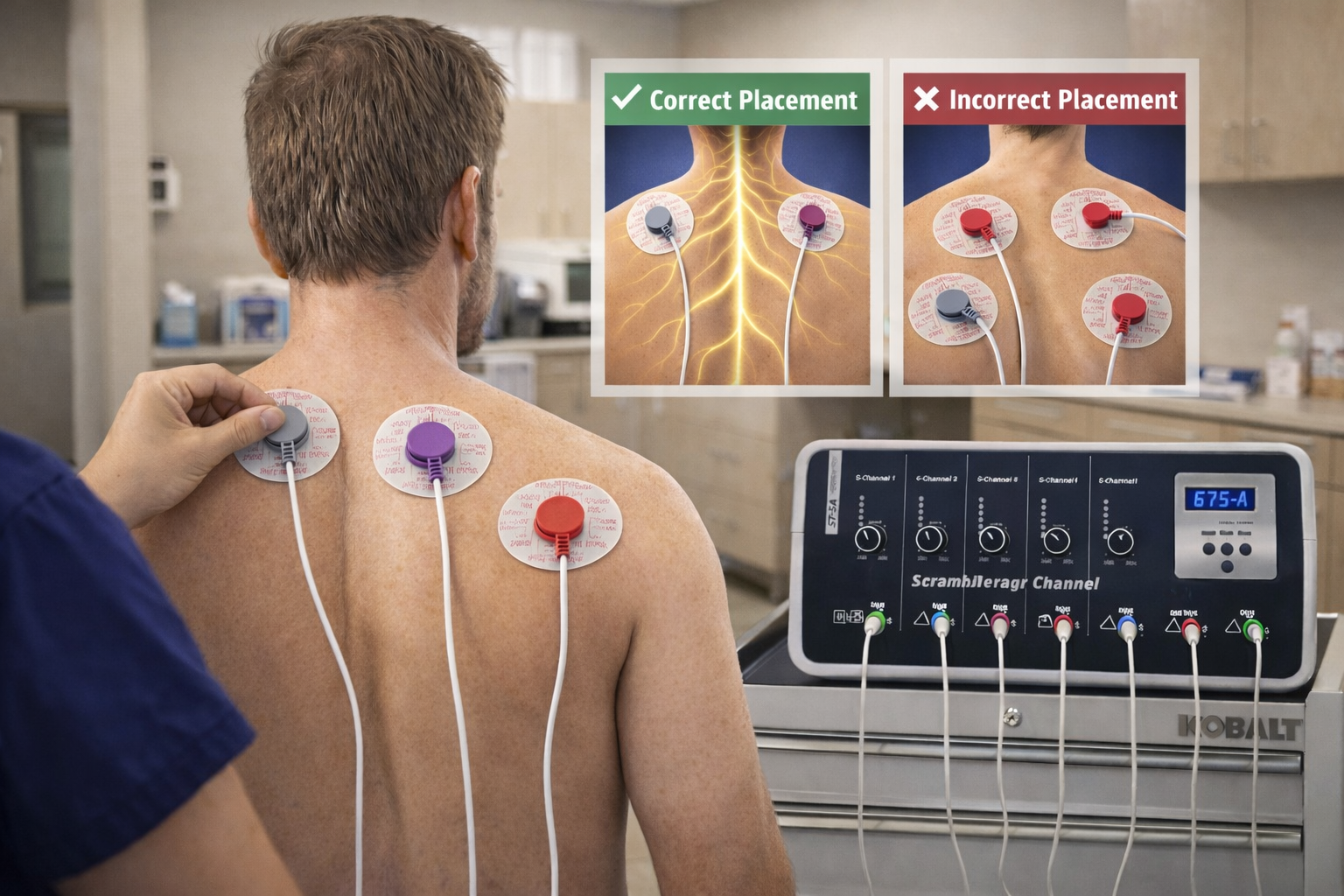
  • Delivers synthetic “non-pain” electrical signals via electrodes
  • Targets C-fibers and A-delta fibers
  • Aims to promote neuroplastic changes

Clinical studies suggest it may reduce pain by replacing abnormal signals with non-pain information, rather than blocking them.

👉 Marineo et al. demonstrated pain reduction using Scrambler Therapy in neuropathic pain patients (Journal of Pain and Symptom Management, 2012)

How Each Treatment Works in the Body

Mechanism of Medications

Medications act through biochemical modulation:

  • Opioids → receptor binding and CNS modulation
  • Gabapentin → calcium channel inhibition
  • Antidepressants → neurotransmitter regulation

These mechanisms reduce pain intensity but may not reverse underlying nerve dysfunction.

👉 First-line pharmacologic treatments for neuropathic pain are summarized in Finnerup et al., 2015 (Lancet Neurology)

Mechanism of Scrambler Therapy

Scrambler Therapy:

  • Sends artificial nerve signals interpreted as “non-pain”
  • Replaces pain signaling patterns
  • Encourages adaptive neuroplasticity over repeated sessions

Some clinical evidence suggests cumulative effects over multiple treatments, rather than immediate suppression.

👉 Smith et al., 2010 reported benefit in chemotherapy-induced neuropathy (Journal of Pain and Symptom Management)

Conditions Commonly Treated

Both approaches are used for neuropathic pain conditions, including:

  • Peripheral neuropathy (including chemotherapy-induced)
  • Diabetic neuropathy
  • Post-herpetic neuralgia
  • Complex Regional Pain Syndrome (CRPS)
  • Failed back surgery syndrome

Medications are widely used as first-line therapy, though incomplete relief is common in chronic cases.
👉 Neuropathic pain often remains refractory despite pharmacologic therapy (Colloca et al., 2017)

Scrambler Therapy may be considered in patients with persistent symptoms, particularly when medication response is limited.

👉 Full condition list

Timeline of Relief

Medications

  • Onset: hours to days
  • Requires continuous use
  • Risk of tolerance and dose escalation

👉 Long-term opioid use is associated with tolerance and dependence (Volkow & McLellan, 2016, NEJM)

Scrambler Therapy

  • Typically delivered over ~10 sessions
  • Sessions last 30–45 minutes
  • Some patients report improvement within several treatments

Clinical responses vary, and benefits may depend on adherence and patient selection.

Safety Profile

Medication Risks

  • Opioid dependence and withdrawal
  • Respiratory depression
  • Cognitive impairment
  • Gastrointestinal effects

👉 Opioid-related risks are well documented in chronic pain management (Dowell et al., CDC Guidelines, 2016)

Scrambler Therapy Safety

  • Non-invasive and drug-free
  • Minimal systemic risk
  • Mild skin irritation may occur

Current studies suggest a favorable safety profile, though larger trials are still needed for long-term evaluation.

Patient Selection and Clinical Evaluation

A structured medical evaluation is essential.

Candidates for Scrambler Therapy may include:

  • Patients with chronic neuropathic pain
  • Those with limited response to medications
  • Individuals experiencing medication side effects

A multidisciplinary approach—combining neurology, pain management, and rehabilitation—often provides the best outcomes.

👉 Meet Our Specialists

Frequently Asked Questions

Is Scrambler Therapy safer long-term?

It may be safer in some cases because it avoids systemic drug exposure. However, treatment decisions should be individualized.

How effective is it compared to medications?

Some studies show meaningful improvement in certain patients, but results vary depending on the condition and severity.
👉 Evidence remains promising but not definitive (Marineo et al., 2012)

Is it a replacement for medications?

Not necessarily. It may be used as:

  • An adjunct therapy
  • An alternative when medications are ineffective or poorly tolerated

Expert Perspective

Neuropathic pain is increasingly understood as a disorder of abnormal neural signaling, not just tissue damage.

  • Medications → modulate chemistry
  • Scrambler Therapy → may influence signaling patterns

Both approaches have roles, and optimal treatment often depends on individual patient response and clinical context.

Full References

Colloca L, Ludman T, Bouhassira D, et al.
Neuropathic pain.
Nature Reviews Disease Primers. 2017;3:17002.

Finnerup NB, Attal N, Haroutounian S, et al.
Pharmacotherapy for neuropathic pain in adults: a systematic review and meta-analysis.
The Lancet Neurology. 2015;14(2):162–173.

Marineo G, Iorno V, Gandini C, Moschini V, Smith TJ.
Scrambler therapy may relieve neuropathic pain: a pilot study. Journal of Pain and Symptom Management. 2012;43(1):87–95.

Smith TJ, Coyne PJ, Parker GL, Dodson P, Ramakrishnan V.  Pilot trial of a patient-specific cutaneous electrostimulation device (MC5-A Calmare®) for chemotherapy-induced peripheral neuropathy.  Journal of Pain and Symptom Management. 2010;40(6):883–891.

Volkow ND, McLellan AT.
Opioid abuse in chronic pain—misconceptions and mitigation strategies.
New England Journal of Medicine. 2016;374(13):1253–1263.

Dowell D, Haegerich TM, Chou R.
CDC guideline for prescribing opioids for chronic pain—United States, 2016.
JAMA. 2016;315(15):1624–1645.

Mayo Clinic
Peripheral neuropathy – Diagnosis and treatment

National Institute of Neurological Disorders and Stroke (NIH)
Peripheral Neuropathy Fact Sheet

Cleveland Clinic
Neuropathy (Peripheral Neuropathy)

Medical Disclaimer

This content is for educational purposes only and does not replace professional medical advice. Always consult a qualified healthcare provider before making treatment decisions.

Take the Next Step

If chronic nerve pain is affecting your daily life, a personalized medical evaluation can help determine the most appropriate treatment approach.

📞 Call: 954-476-6661
📅 Or schedule a consultation to explore non-invasive options

Patient Reviews

"I am so thankful for the relief I found through Scrambler Therapy. After years of chronic pain from neuropathy, I finally have my life back. The team truly cares about their patients."
Melissa Chen
2 weeks ago
"I am so thankful for the relief I found through Scrambler Therapy. After years of chronic pain from neuropathy, I finally have my life back. The team truly cares about their patients."
Melissa Chen
2 weeks ago
"I am so thankful for the relief I found through Scrambler Therapy. After years of chronic pain from neuropathy, I finally have my life back. The team truly cares about their patients."
Melissa Chen
2 weeks ago
"I am so thankful for the relief I found through Scrambler Therapy. After years of chronic pain from neuropathy, I finally have my life back. The team truly cares about their patients."
Melissa Chen
2 weeks ago
"I am so thankful for the relief I found through Scrambler Therapy. After years of chronic pain from neuropathy, I finally have my life back. The team truly cares about their patients."
Melissa Chen
2 weeks ago
"I am so thankful for the relief I found through Scrambler Therapy. After years of chronic pain from neuropathy, I finally have my life back. The team truly cares about their patients."
Melissa Chen
2 weeks ago
Trusted Relief in South Florida Scrambler Therapy

Start Your Nerve Pain-Free Journey Today

Don't let nerve pain discomfort control your life. Call today or book online to see if this is right for you.
natural treatment for nerve pain