.webp)
.jpeg)
If you’re living with chronic nerve pain, you may have heard this before:
“Your imaging looks normal.”
Yet the pain continues.
For many patients, the issue is no longer structural damage; it’s how the nervous system is processing pain signals. This is where the concept of “rewiring pain pathways” becomes clinically relevant.
Rewiring pain pathways refers to supporting adaptive neuroplasticity, the nervous system’s ability to change how it processes signals over time.
Chronic neuropathic pain often involves a process called sensitization, where the nervous system becomes overreactive.
Research in pain neuroscience identifies three major contributors:
Damaged or irritated nerves become hypersensitive, causing normally non-painful stimuli to feel painful.¹
Neurons in the spinal cord’s dorsal horn amplify incoming signals, similar to a car alarm triggered by a light breeze.²
Brain imaging studies show that chronic pain can alter the somatosensory cortex, the brain’s body map, leading to distorted pain perception.³
Neuroplasticity means these changes are not necessarily permanent. With the right input, the nervous system can adapt.
Chronic pain is often a nervous system problem — not a tissue problem.
Understanding how chronic pain becomes “wired in” helps explain why traditional approaches sometimes fall short. When medications, injections, or even surgery address tissue but not maladaptive neural signaling, symptoms may continue despite normal imaging. For this reason, neuromodulation-based approaches that target nervous system processing, not just anatomy, are increasingly explored in neuropathic pain management.
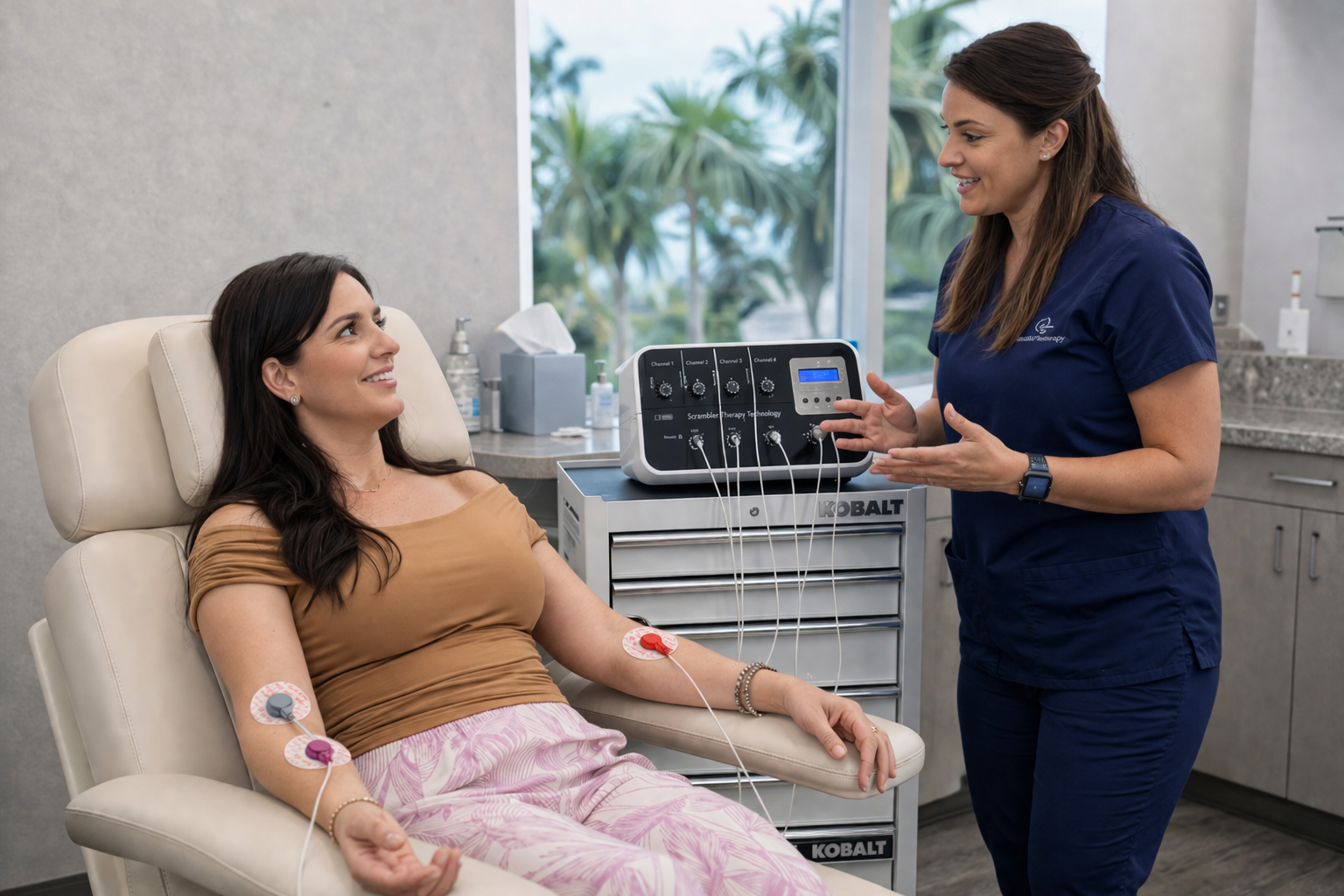
At South Florida Scrambler Therapy, we utilize FDA-cleared Scrambler Therapy® (510(k) cleared device) as part of a structured neuroplasticity-based approach.
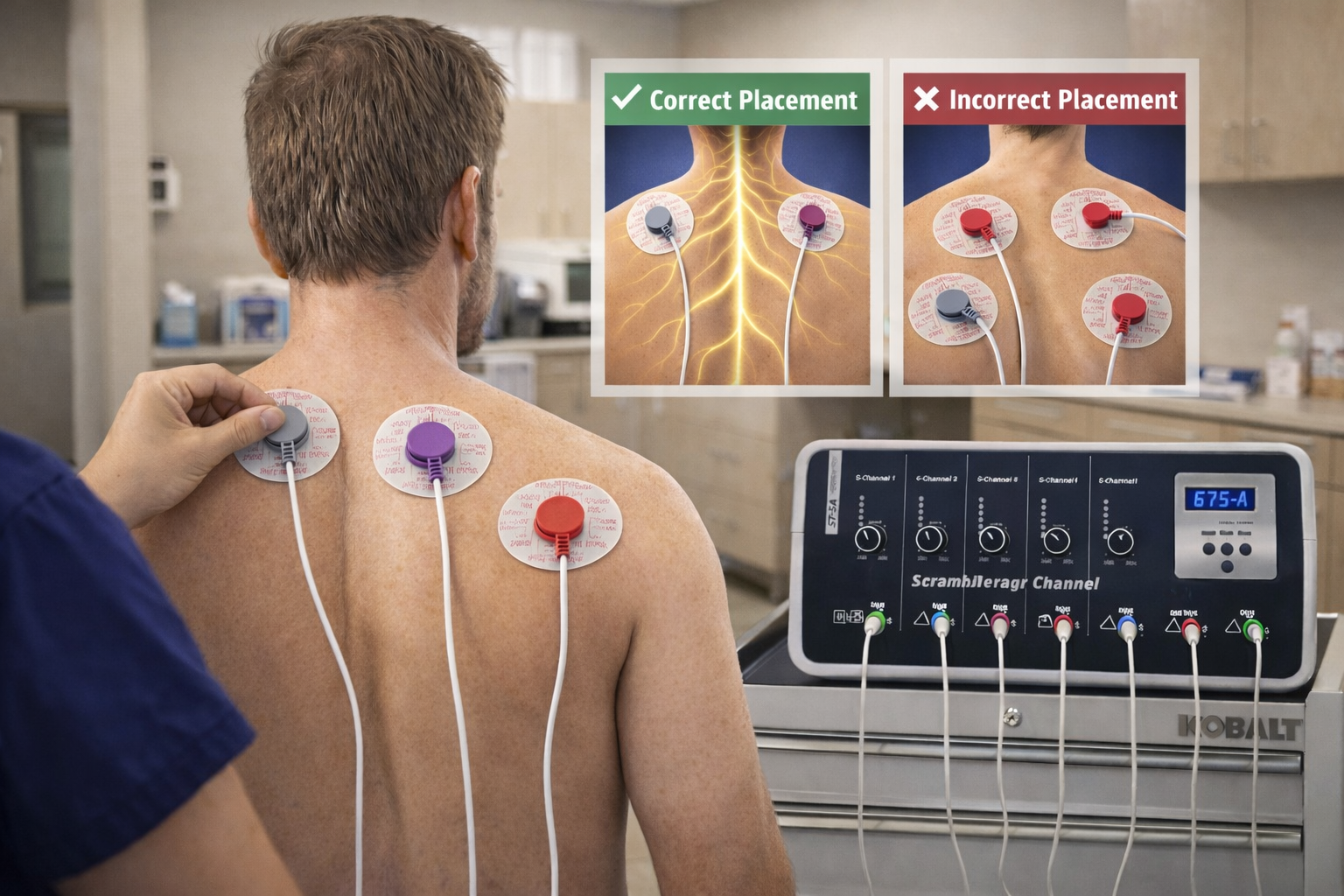
Unlike TENS units, which primarily stimulate nerves to block pain temporarily, Scrambler Therapy delivers synthetic “non-pain” information through surface electrodes. The therapy aims to replace persistent pain signaling with synthetic non-pain information, potentially reducing central amplification over time.⁴
The treatment is non-invasive and typically administered over a series of sessions.
Patients often ask how Scrambler Therapy differs from other electrical pain treatments.
TENS (Transcutaneous Electrical Nerve Stimulation) primarily works by temporarily blocking pain signals through surface stimulation. Relief typically lasts only while the device is active and does not aim to modify long-term pain processing.
Spinal Cord Stimulation (SCS) is an implanted device that delivers electrical impulses directly to the spinal cord. While it may provide relief for certain patients, it involves surgery, device implantation, and ongoing hardware management.
Scrambler Therapy, by contrast, is non-invasive and delivered through surface electrodes. It is designed to transmit synthetic “non-pain” information along C-fibers with the goal of modulating maladaptive pain signaling over time, without surgical implantation.
Each treatment option has specific indications, and careful evaluation helps determine the most appropriate approach.
Your journey begins with a detailed consultation and pain mapping process to understand how your nervous system is processing signals.
A typical protocol may include:
Some patients report improvement during early sessions, though responses vary.
Scrambler Therapy has been studied in conditions such as:
Clinical studies report meaningful pain reduction and improved function in many neuropathic pain populations.⁴ ⁵
Scrambler Therapy is non-invasive and generally well tolerated.
Possible mild side effects may include:
It may not be appropriate for individuals with:
An individualized consultation is required to determine candidacy.
While Scrambler Therapy is non-invasive and generally well tolerated, it is not appropriate for everyone.
This treatment may not be recommended for individuals with:
Each patient requires an individualized evaluation to determine whether this therapy is clinically appropriate. A comprehensive consultation ensures safety and proper treatment planning.
The device is FDA-cleared under the 510(k) process, meaning it met safety standards and substantial equivalence requirements. FDA clearance does not imply guaranteed effectiveness, and individual outcomes may vary.
No. TENS blocks pain signals temporarily, while Scrambler Therapy aims to modulate pain signaling through synthetic non-pain input.
Duration varies. Some patients report sustained improvement, while others may require maintenance sessions.
The therapy is designed to be non-painful.
Most treatment plans involve approximately 10 sessions delivered over two weeks. Progress is monitored throughout the process, and response varies between individuals.
This content is provided for educational and informational purposes only and does not constitute medical advice, diagnosis, or treatment. Scrambler Therapy and other treatments discussed may not be appropriate for all individuals. Outcomes vary by patient. Always consult a licensed healthcare professional to determine whether a specific treatment is appropriate for your condition. If you are experiencing a medical emergency, call 911 or seek immediate medical care.
Keep up to date with important news about our clinic and your medical records.



.svg)
.svg)
.svg)